Our friends and neighbors on the Leonia Environmental Commission are doing tremendous work, and I want to offer special thanks to Chair Karen Marx and Councilman Christoph Hesterbrink, who successfully applied for and received a grant from ANJEC (the Association of New Jersey Environmental Commissions) and VEOLIA for Highwood Hills.
In the late 1970’s Highwood Hills was being considered for development as apartments. Fortunately, the majority of the Mayor and Council at the time disabused that notion and kept it as a natural wilderness with Green Acres protections. If our development of the northeast section of town is any indication of what can happen when 100% residential development is undertaken (at least as it relates to increases in educational and municipal service costs), then we can thank our lucky stars we dodged that bullet with the notable support of Supreme Court Justice William O. Douglas.
We will be using this ANJEC grant to improve signage and add another path. We invite you to enjoy these woods. Dogs on leash are welcome. The entrance is at the intersection of Paulin Blvd. and Highwood Avenue.
We will be holding volunteer work days to spread wood chips on the paths and would appreciate any help we can get. Please check out the Environmental Commission’s webpages on the Leonia Borough website. There you will find a lot of information including how you can reduce waste and increase recycling. We will be adding a Highwood Hills specific page soon.
If you want to volunteer for the next Highwood Hills project events, please click HERE.
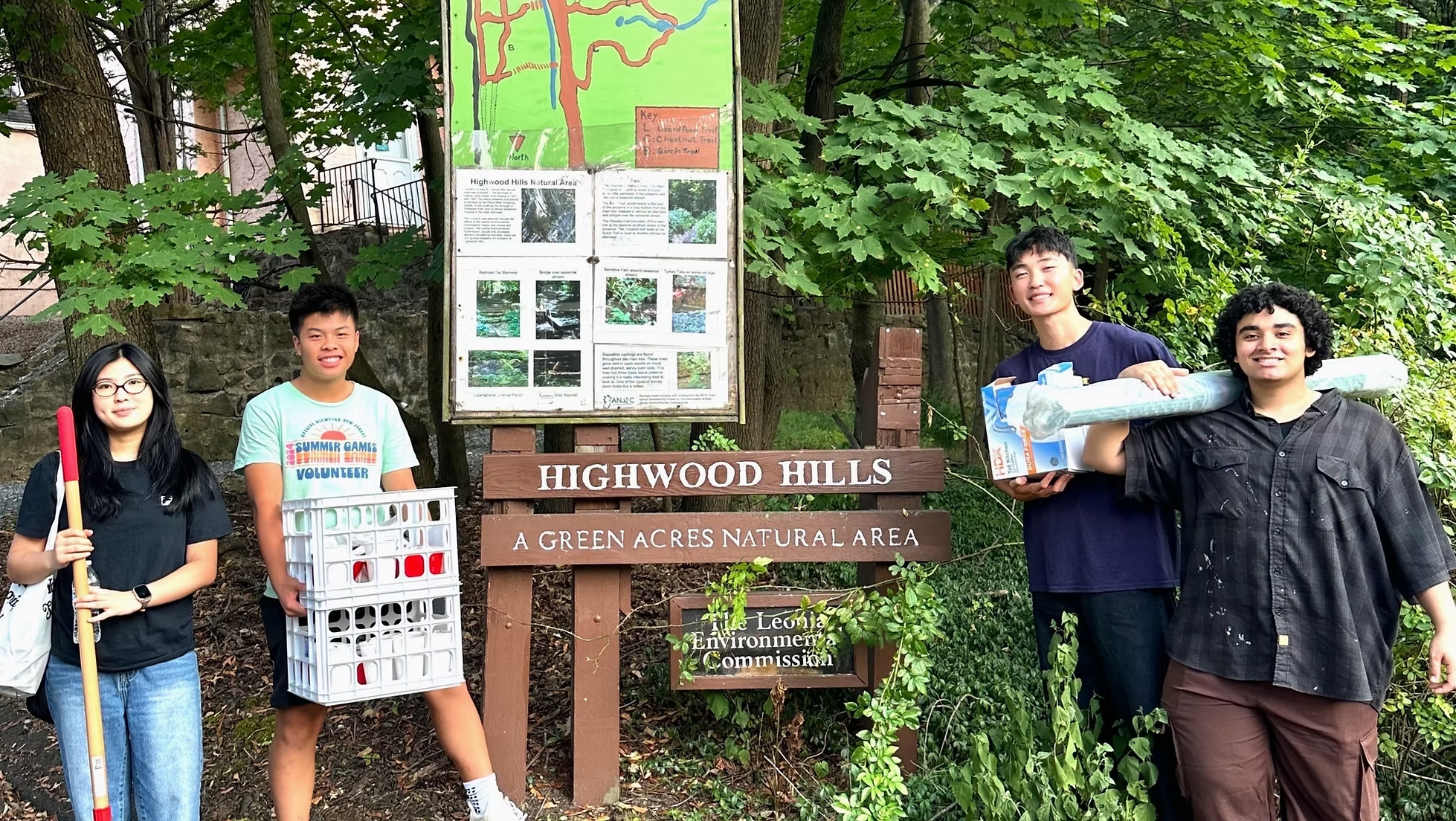
Re:Imagine, a group of volunteers and researchers solving pressing ecological problems through research, restoration, and redesign, is using as a resource Highwood Hills in the quest to answer this question:how might we give back to our local communities by restoring our parks, forests, andgreen spaces in a way that is both practical and ecologically sound?
Young volunteers Justin Ahn, Danielle (Elle) Kim, Muhammad El-Sherbiny, Leo Toake, say in their project report: “In the rolling woodlands of Englewood Cliffs’ Flat Rock Brook Nature Center and the gentle slopes of Leonia’s Highwood Hills, we witnessed invasive species—Japanese stiltgrass and Asiatic tearthumb—rapidly overrunning the understory, outcompeting native wildflowers and saplings, and undermining the very foundation of our region’s biodiversity. At the same time, our community’s cafés and restaurants were discarding hundreds of pounds of compostable food waste each week—potato peels, coffee grounds, apple cores—bound for landfills to emit methane rather than nourish local soils. We saw these twin crises not as separate problems, but as opportunities for innovation,” they explain in their project report.
“Our project was built around three interconnected steps that needed to work together: (1) creating a sustainable, natural herbicide using food waste; (2) restoring native biodiversity through keystone plantings; and (3) organizing community trail cleanups to keep local nature spaces healthy and accessible.”
This team got measurable results: “Over the course of our project, we processed more than 500 pounds of food waste collected from local businesses, converting potato peels, coffee grounds, and other compostable scraps into our S.A.F.E. natural herbicide. In controlled in vitro assays, this formulation was shown to suppress growth in a dose-dependent manner, with 490 mg/L concentrations inhibiting invasive plant germination by 50%—an encouraging result that we hope to validate in upcoming field trials. Building on these laboratory successes, we plan to deploy varying concentrations andencapsulation systems on 15 acres of invasive-dominated plots in Englewood Cliffs and Leonia, guided by our optimized extraction protocols and mushroom-enzyme assay for chlorogenic acid quantification.”
“On the restoration front, we planted over 100 keystone native species—including white oak saplings, milkweed, and pollinator-supporting perennials—across those treated areas to rebuild habitat structure and floral diversity. Twelve cleanup events brought together more than 60 volunteers from Bergen County Academies, Leonia High School, community groups, and municipal staff, who together removed 605 pounds of litter and cleared 1.5 tons of invasive plant material. Our work garnered direct praise from a diverse array of stakeholders—including Leonia’s Environmental Commission, the land manager and executive director of Flat Rock Brook Nature Center, the staff at Marty’s (voted the best burger spot in New Jersey), and the many students who earned community service hours with our organization—for our innovative, community-driven approach.”
This team was recognized as a top prize winner at the 2025 NJ State Science Day, a statewide competition sponsored by the Research & Development Council of New Jersey and the NJ Science Teachers Association, highlighting our innovative approach to sustainable herbicide development and earned 3rd Prize nationally in the Bill of Rights Institute’s MyImpact Challenge for civic engagement through environmental stewardship!