Justice and His Wife Back Sanctuary in Leonia
By Will Lissner Special To the New York Times
April 1, 1967
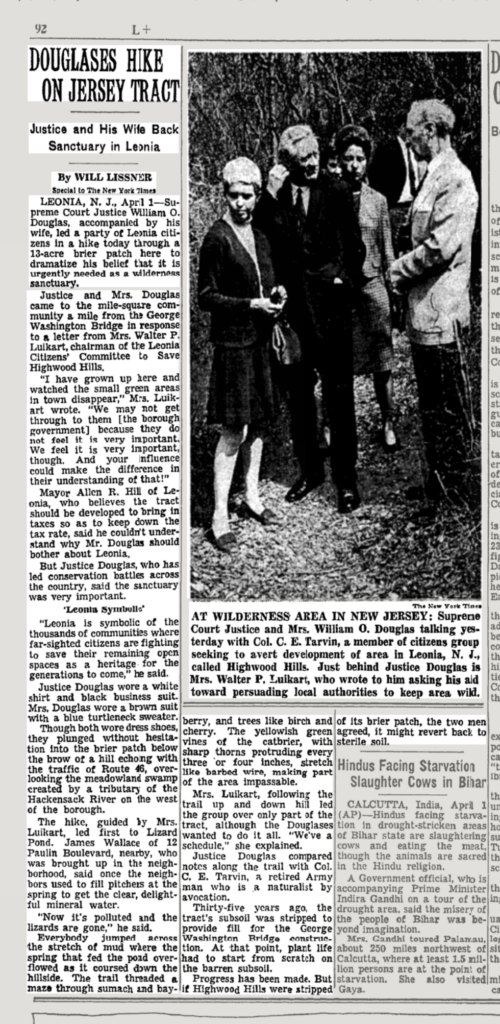
LEONIA, N. J., April 1—Supreme Court Justice William O. Douglas, accompanied by his wife, led a party of Leonia citizens in a hike today through a 13-acre brier patch here to dramatize his belief that it is urgently needed as a wilderness sanctuary.
Justice and Mrs. Douglas came to the mile-square community a mile from the George Washington Bridge in response to a letter from Mrs. Walter P. Luikart, chairman of the Leonia Citizens’ Committee to Save Highwood Hills.
“I have grown up here and watched the small green areas in town disappear,” Mrs. Luikart wrote. “We may not get through to them [the borough government] because they do not feel it is very important. We feel it is very important, though. And your influence could make the difference in their understanding of that!”
Mayor Allen R. Hill of Leonia, who believes the tract should be developed to bring in taxes so as to keep down the tax rate, said he couldn’t understand why Mr. Douglas should bother about Leonia.
But Justice Douglas, who has led conservation battles across the country, said the sanctuary was very important.
‘Leonia Symbolic’
“Leonia is symbolic of the thousands of communities where far-sighted citizens are fighting to save their remaining open spaces as a heritage for the generations to come,” he said.
Justice Douglas wore a white shirt and black business suit. Mrs. Douglas wore a brown suit with a blue turtleneck sweater. Though both wore dress shoes, they plunged without hesitation into the brier patch below the brow of a hill echoing with the traffic of Route 46, overlooking the meadowland swamp created by a tributary of the Hackensack River on the west of the borough.
The hike, guided by Mrs. Luikart, led first to Lizard Pond. James Wallace of 12 Paulin Boulevard, nearby, who was brought up in the neighborhood, said once the neighbors used to fill pitchers at the spring to get the clear, delightful mineral water.
“Now it’s polluted and the lizards are gone,” he said.
Everybody jumped across the stretch of mud where the spring that fed the pond overflowed as it coursed down the hillside. The trail threaded a maze through sumach and bayberry, and trees like birch and cherry. The yellowish green vines of the catbrier, with sharp thorns protruding every three or four inches, stretch like barbed wire, making part of the area impassable.
Mrs. Luikart, following the trail up and down hill led the group over only part of the tract, although the Douglases wanted to do it all. “We’ve a schedule,” she explained.
Justice Douglas compared notes along the trail with Col. C. E. Tarvin, a retired Army man who is a naturalist by avocation.
Thirty-five years ago, the tract’s subsoil was stripped to provide fill for the George Washington Bridge construction. At that point, plant life had to start from scratch on the barren subsoil.
Progress has been made. But if Highwood Hills were stripped of its brier patch, the two men agreed, it might revert back to sterile soil.