Author: jessie

  • Environmental Commission Wins Grant from ANJEC and VEOLIA 

    Environmental Commission Wins Grant from ANJEC and VEOLIA 

    November 5, 2025

    Update from Mayor Bill Zeigler

    Our friends and neighbors on the Leonia Environmental Commission are doing tremendous work, and I want to offer special thanks to Chair Karen Marx and Councilman Christoph Hesterbrink, who successfully applied for and received a grant from ANJEC (the Association of New Jersey Environmental Commissions) and VEOLIA for Highwood Hills. 

    In the late 1970’s Highwood Hills was being considered for development as apartments.  Fortunately, the majority of the Mayor and Council at the time disabused that notion and kept it  as a natural wilderness with Green Acres protections.  If our development of the northeast section of town is any indication of what can happen when 100% residential development is undertaken (at least as it relates to increases in educational and municipal service costs), then we can thank our lucky stars we dodged that bullet with the notable support of Supreme Court Justice William O. Douglas.   

    We will be using this ANJEC grant to improve signage and add another path.  We invite you to enjoy these woods.  Dogs on leash are welcome.  The entrance is at the intersection of Paulin Blvd. and Highwood Avenue.  

    We will be holding volunteer work days to spread wood chips on the paths and would appreciate any help we can get.  Please check out the Environmental Commission’s webpages on the Leonia Borough website.  There you will find a lot of information including how you can reduce waste and increase recycling.  We will be adding a Highwood Hills specific page soon.

    If you want to volunteer for the next Highwood Hills project events, please click HERE.

  • Transforming Food Waste Into S.A.F.E. Ecological Impact

    Transforming Food Waste Into S.A.F.E. Ecological Impact

    Re:Imagine, a group of volunteers and researchers solving pressing ecological problems through research, restoration, and redesign, is using as a resource Highwood Hills in the quest to answer this question:how might we give back to our local communities by restoring our parks, forests, and green spaces in a way that is both practical and ecologically sound? 

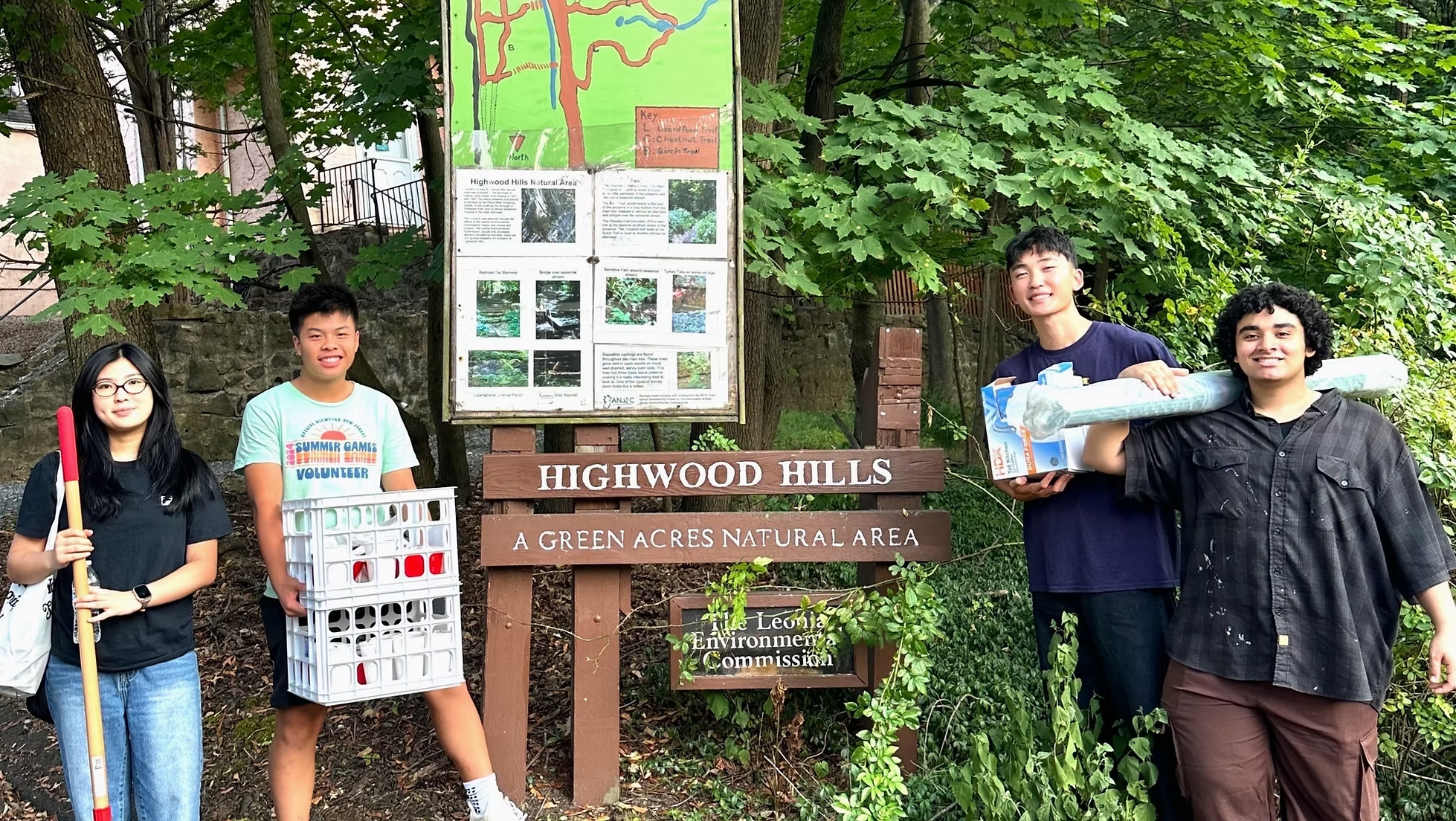
    Young volunteers Justin Ahn, Danielle (Elle) Kim, Muhammad El-Sherbiny, Leo Toake, say in their project report: “In the rolling woodlands of Englewood Cliffs’ Flat Rock Brook Nature Center and the gentle slopes of Leonia’s Highwood Hills, we witnessed invasive species—Japanese stiltgrass and Asiatic tearthumb—rapidly overrunning the understory, outcompeting native wildflowers and saplings, and undermining the very foundation of our region’s biodiversity. At the same time, our community’s cafés and restaurants were discarding hundreds of pounds of compostable food waste each week—potato peels, coffee grounds, apple cores—bound for landfills to emit methane rather than nourish local soils. We saw these twin crises not as separate problems, but as opportunities for innovation,” they explain in their project report.

    “Our project was built around three interconnected steps that needed to work together: (1) creating a sustainable, natural herbicide using food waste; (2) restoring native biodiversity through keystone plantings; and (3) organizing community trail cleanups to keep local nature spaces healthy and accessible.”

    This team got measurable results: “Over the course of our project, we processed more than 500 pounds of food waste collected from local businesses, converting potato peels, coffee grounds, and other compostable scraps into our S.A.F.E. natural herbicide. In controlled in vitro assays, this formulation was shown to suppress growth in a dose-dependent manner, with 490 mg/L concentrations inhibiting invasive plant germination by 50%—an encouraging result that we hope to validate in upcoming field trials. Building on these laboratory successes, we plan to deploy varying concentrations andencapsulation systems on 15 acres of invasive-dominated plots in Englewood Cliffs and Leonia, guided by our optimized extraction protocols and mushroom-enzyme assay for chlorogenic acid quantification.”

    “On the restoration front, we planted over 100 keystone native species—including white oak saplings, milkweed, and pollinator-supporting perennials—across those treated areas to rebuild habitat structure and floral diversity. Twelve cleanup events brought together more than 60 volunteers from Bergen County Academies, Leonia High School, community groups, and municipal staff, who together removed 605 pounds of litter and cleared 1.5 tons of invasive plant material. Our work garnered direct praise from a diverse array of stakeholders—including Leonia’s Environmental Commission, the land manager and executive director of Flat Rock Brook Nature Center, the staff at Marty’s (voted the best burger spot in New Jersey), and the many students who earned community service hours with our organization—for our innovative, community-driven approach.”

    This team was recognized as a top prize winner at the 2025 NJ State Science Day, a statewide competition sponsored by the Research & Development Council of New Jersey and the NJ Science Teachers Association, highlighting our innovative approach to sustainable herbicide development and earned 3rd Prize nationally in the Bill of Rights Institute’s MyImpact Challenge for civic engagement through environmental stewardship!

  • Trail Maintenance: April 2026

    Trail Maintenance: April 2026

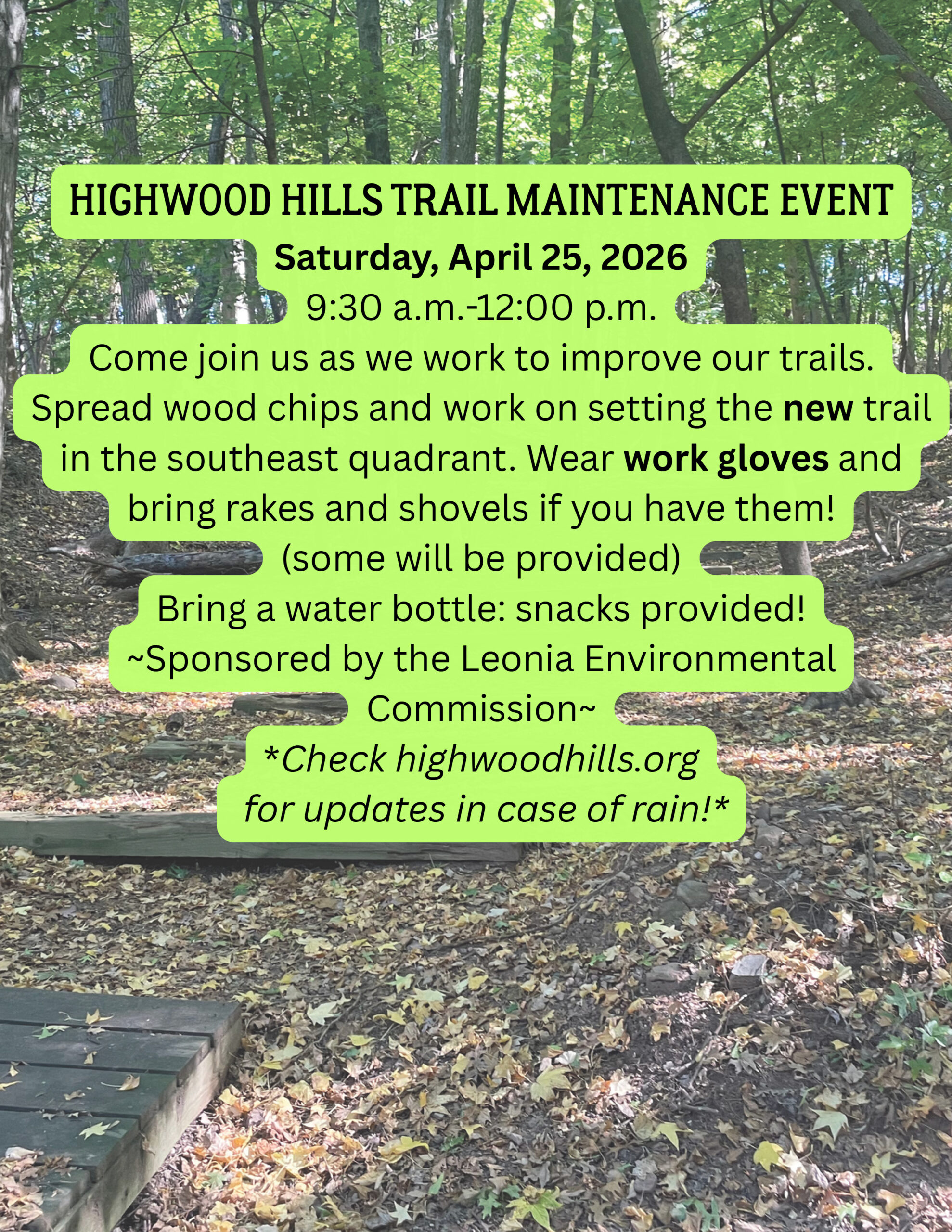
    Saturday, April 25, 2026 from 9:30 a.m. – 12 p.m.
    Come join us as we work to improve our trails. Spread wood chips and work on setting the new trail in the southeast quadrant. Wear work gloves and bring rakes and shovels if you have them! (some will be provided)

    Bring a water bottle: snacks provided!

    ~Sponsored by the Leonia Environmental Commission~

  • Haunted Hills

    Haunted Hills

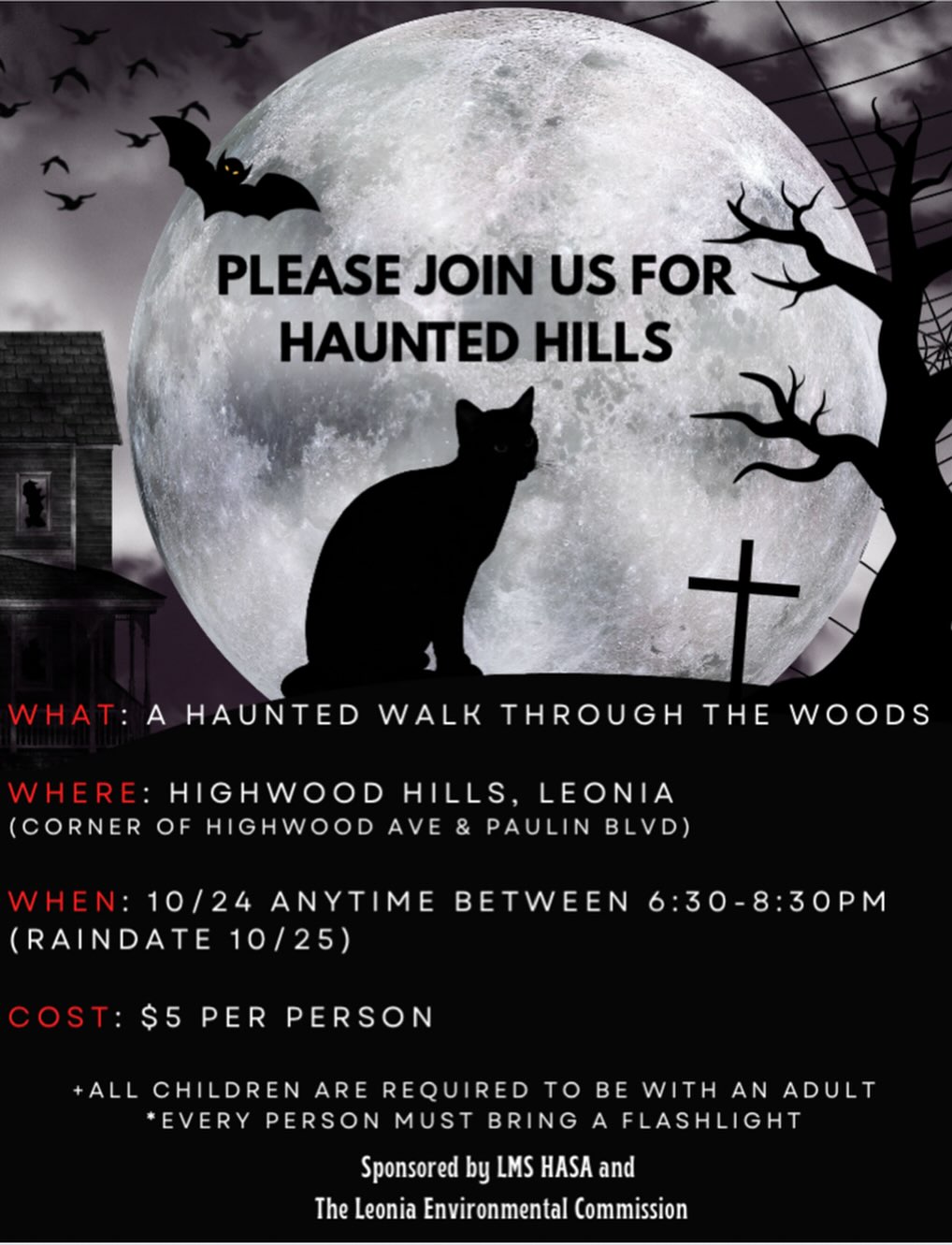
    October 24, 2025 from 6:30 – 8:30pm

    Get ready for a spooky night at Haunted Hills — a haunted walk through the woods at Highwood Hills in Leonia (corner of Highwood Ave & Paulin Blvd) on Friday, October 24th from 6:30–8:30 PM, with a rain date of October 25th. Admission is $5 per person. All children must be accompanied by an adult, and every guest must bring a flashlight to light the way. Dare to join us… if you’re brave enough! 👻

    Sponsored by the Leonia Middle School Home and School Association and the Leonia Environmental Commission

  • Field Experimentation at Highwood Hills

    Field Experimentation at Highwood Hills

    Aug 3, 2025 at 12:00 PM

    Re:Imagine applies 30 different herbicide formulations in Leonia, NJ

    Following the successful creation of our research laboratory in Tenafly, Re:imagine has officially launched its first wave of field experimentation at Highwood Hills, one of our partner environmental centers.

    Over the course of two intensive days, Re:imagine members each dedicated approximately 15 hours to develop and apply 30 different preliminary herbicide formulations, each designed to combat invasive plant species threatening local biodiversity. These formulations were carefully prepared and labeled in our newly founded lab.

    We identified and cleared over a ton of invasive growth across thirty 1-square-meter plots, each assigned to one of the formulations. After thoroughly removing invasive plants by hand, each plot was treated with its assigned herbicide and carefully raked in to ensure soil contact. Every plot was photographed, mapped, and geolocated to support detailed, long-term monitoring.

    In the coming months, our team will be tracking changes in regrowth, biodiversity, and soil health using both in-lab analysis and field observations. We hope to assess the short- and long-term efficacy of our homemade herbicides.

    We are so excited to see where this data leads, and to continue reimagining what’s possible for local ecosystems!

    Learn More

  • New York Times: Leonia Park Still Disputed

    New York Times: Leonia Park Still Disputed

    Special to the New York Times

    Sunday, April 15, 1973

    LEONIA—As the glitter of spring settles in over the craggy woodland of Highwood Hills, it is difficult to believe that it was only 18 months ago that this placid tract had churned up a good deal of political froth and some bitter factional debates in this otherwise sedate community.

    The 14‐acre site— it is mostly borough‐owned — is still, in the words of one local official, “an open wound.”

    This woodland, some say, would carry a price tag of about $4‐million on a realestate auction block. And many residents view the tract not as a sanctuary away from urban stress, but as a high‐potency tax generator that is not being exploted.

    The local spotlight was focused on the site during the 1971 municipal campaign, a political fray that produced one of Bergen County’s most stunning upsets. In unusually heavy off-year balloting, Democrats seized the mayoralty and control of the Borough Council for the first time in the town’s long history of automatic Republican shoo-ins.

    On the same ballor that swept Mayor Tom Ford into power, voters gave the nod, 1,876 to 1,515 to a referendum granting a 10-year lease on the property to the nature center group.

    In addition to the systematic mobilization of proecology forces, a contributing factor in the nature center victory was a public endorsement of the proposal by Supreme Court Justice William O. Douglas.

    The ecology group, which had emerged slowly over a 10‐year period, and whose membership now numbers about 200 borough families, had pushed vigorously during the year preceding the election to have the site designated as a permanent park. The lease arrangement was viewed as a compromise solution.

    Nonetheless, says Mayor Ford, his administration is going ahead with its hopes of having the tract dedicated permanently as a nature site. Hopes for receiving a Federal grant from the Department of Housing and Urban Development have been set back as a results of President Nixon’s budget, however there are plans to try to move forward with an application for state “Green Acre” funds, which would enable the borough to purchase smaller, enclave-like plots within the borough tract.

    Mr. Ford said that Green Acre funds were also frozen at this time as a result of the Legislature’s failure to appropriate more than one-fourth of the $40 million that state voters decided to commit to Green Acres in a 1971 referendum. Green Acre funds are granted to municipalities for the purchase of undeveloped tracts, which are then dedicated as parks or natural sites.

    A ‘Loose Agreement’

    “What we have now is nothing more than a rather loose agrement with the nature center’s board of directors,” Mr. Ford observed.

    But the mayor says he is heartened by what he feels is a perceptible switch — even among more conservative segments of the borough electorate — from preoccupations with tax ratables to a broader concern with the quality of life.

    “The issue may be cranked up when the lease comes up for renewal,’ Mr. Ford declared, “but I feel the majority will want to keep the tract as a nature center.”

    The opposition leader is John Wragge, a long ‐ time borough resident who served on a municipal committee that was established to study the site.

    Admitting that “for the moment, it’s no longer an issue,” Mr. Wragge declared that he and many of those who voted against the proposal were still convinced that the decision to “freeze” the property was a mistake.

    Of the seven members who served with him on the study committee, he said, only one favored any kind of leasing or dedication of the site. He and other committee members, Mr. Wragge insists, cautioned strongly against entering into any sort of agreement that would tie up the property and prevent its development into tax ratables.

    Empahsis on Taxes

    Mr. Wragge insists that, until the state’s tax structure is changed, with a shift away from heavy dependence upon local levies, the site must be viewed principally as a tax generator.

    In his view, the tract, with its spectacular views, would lend itself to development either with luxury one-family homes or medium-rise apartment houses.

    Acknowledging that his opposition forces had been caught up in a “sociological-economic” debate at the time of the referendum, Mr. Wragge says that the nature center is not really necessary, since the borough already has adequate park facilites.

    Moreover, he added, Leonia already overextended itself in 1950 by deeding 120 acres to the county for development as part of Overpeck County Park.

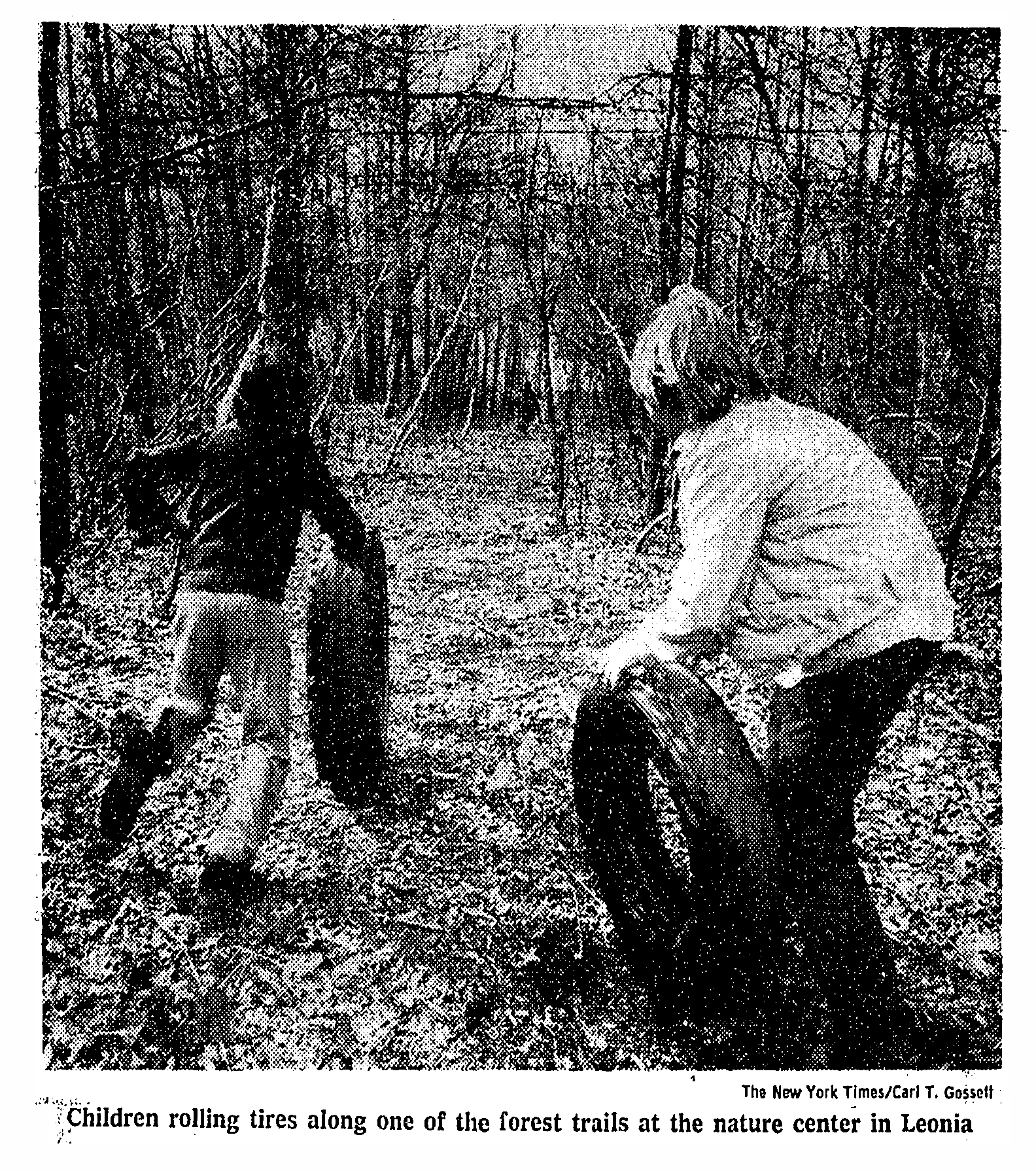
    Meanwhile, depsite all the political fireworks still simmering in the community, nature center members are moving forward with an impressive program for the spring and summer. It includes nature walks and talks, an Easter egg hunt, bird watching, nature sketching and sculpture, geology field trips and a jazz concert.

    In addition, the center regularly conducts courses in field biology for elementary and high school students.

    The nature center’s board of trustees, which is in the midst of changing chairmen following the resignation of Joan Luikart—she withdrew to pursue doctoral studies—has hired a part‐time director for the summer.

    He is Tor Hansen, a young artist-naturalist from Englewood, who is active with the nearby Tenafly Nature Center. Mr. Hansen says he is looking forward to helping borough children explore the site and study the many varieties of plant, animal and insect life that abound there.

    Children, he says, seem to be the ones who have the deepest appreciation and feel the deepest exhilaration in the presence of nature. His role, as Mr. Hansen views it, is to help them in the “big battle: the swing back from the megalopolis concept of living.”

  • New York Times: Justice Douglas Supports Plan To Preserve Leonia Woodlands

    New York Times: Justice Douglas Supports Plan To Preserve Leonia Woodlands

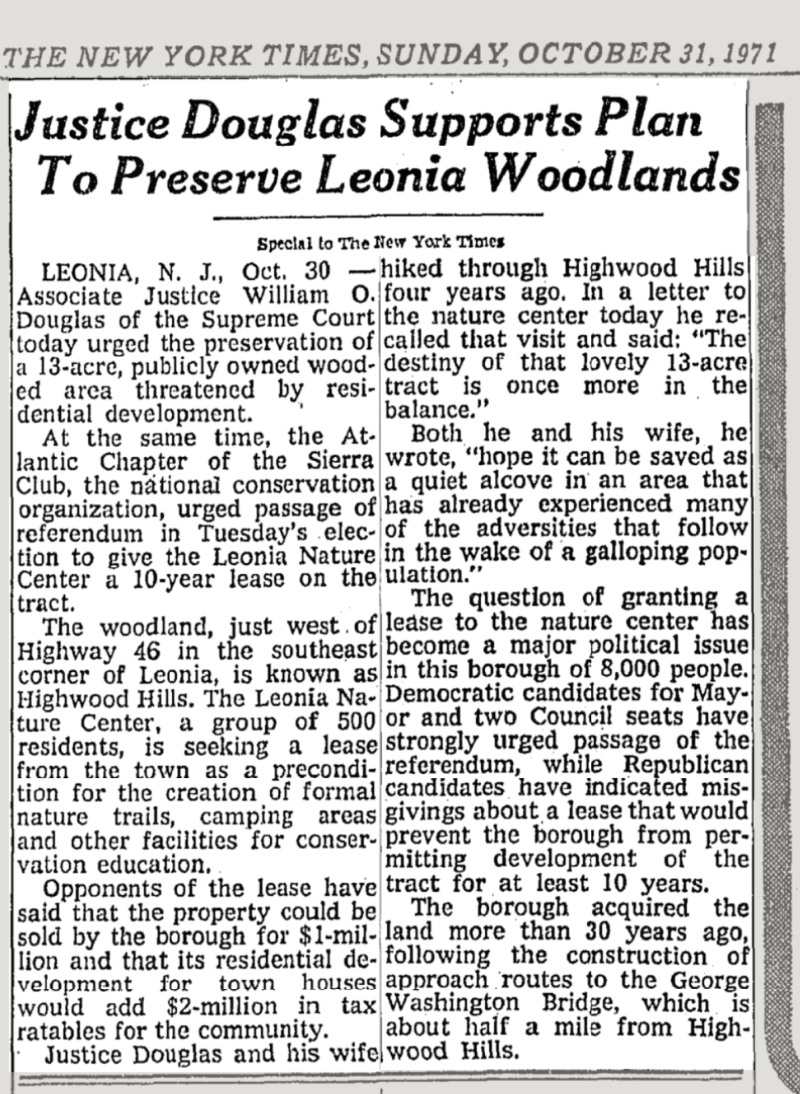
    LEONIA, N. J., Oct, 30 —Associate Justice William O. Douglas of the Supreme Court today urged the preservation of a 13‐acre, publicly owned wooded area threatened by residential development.

    At the same time, the Atlantic Chapter of the Sierra Club, the national conservation organization, urged passage of referendum in Tuesday’s election to give the Leonia Nature Center a 10‐year lease on the tract.

    The woodland, just west, of Highway 46 in the southeast corner of Leonia, is known as Highwood Hills. The Leonia Nature Center, a group of 500 residents, is seeking a lease from the town as a precondition for the creation of formal nature trails, camping areas and other facilities for conservation education.

    Opponents of the lease have said that the property could be sold by the borough for $1‐million and that its residential development for town houses would add $2‐million in tax ratables for the community.

    Justice Douglas and his wife hiked through Highwood Hills four years ago. In a letter to the nature center today he recalled that visit and said: “The destiny of that lovely 13‐acre tract is once more in the balance.”

    Both he and his wife, he wrote, “hope it can be saved as a quiet alcove in an area that has already experienced many of the adversities that follow in the wake of a galloping population.”

    The question of granting a lease to the nature center has become a major political issue in this borough of 8,000 people. Democratic candidates for Mayor and two Council seats have strongly urged passage of the referendum, while Republican candidates have indicated misgivings about a lease that would prevent the borough from permitting development of the tract for at least 10 years.

    The borough acquired the land more than 30 years ago, following the construction of approach routes to the George Washington Bridge, which is about half a mile from Highwood Hills.

  • New York Times: Douglases Hike on Jersey Tract

    New York Times: Douglases Hike on Jersey Tract

    Justice and His Wife Back Sanctuary in Leonia

    By Will Lissner Special To the New York Times

    April 1, 1967

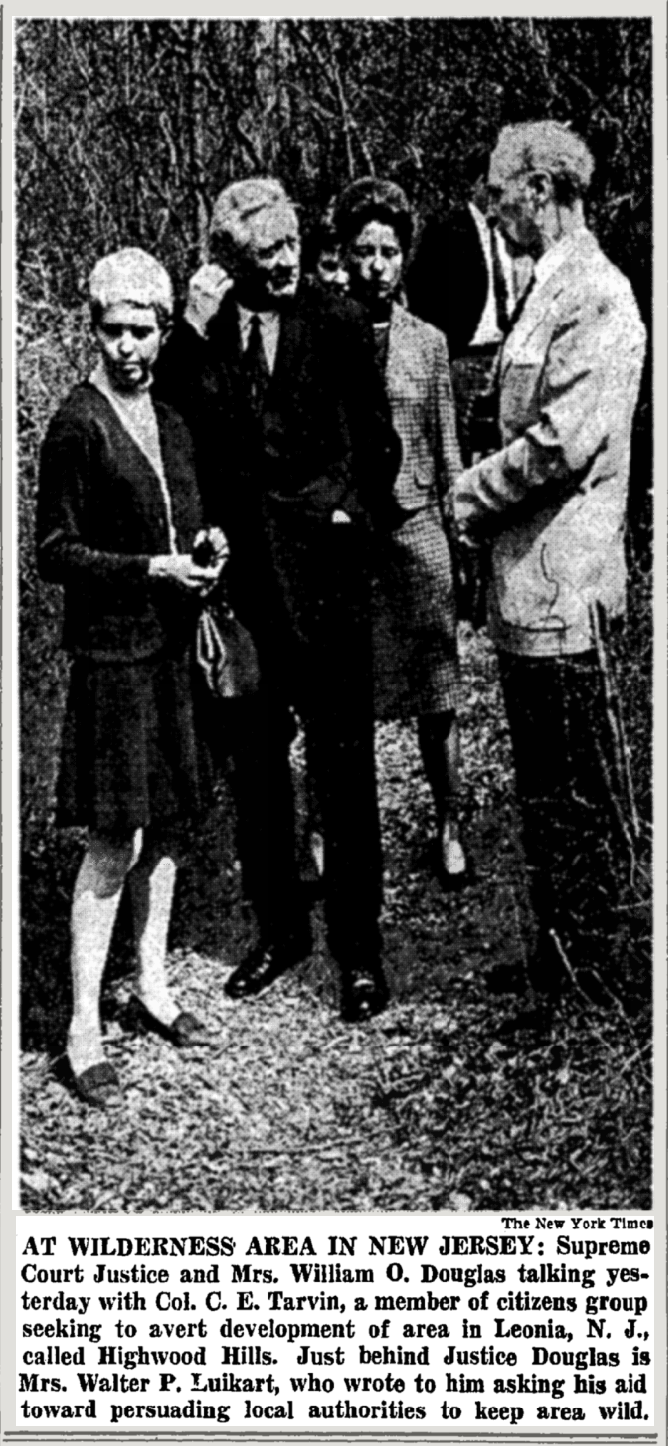
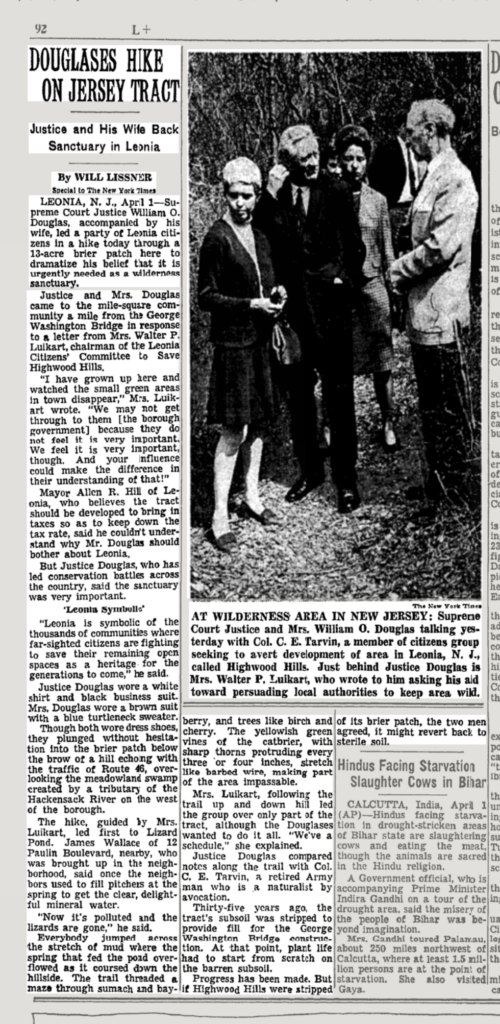
    LEONIA, N. J., April 1—Supreme Court Justice William O. Douglas, accompanied by his wife, led a party of Leonia citizens in a hike today through a 13-acre brier patch here to dramatize his belief that it is urgently needed as a wilderness sanctuary.

    Justice and Mrs. Douglas came to the mile-square community a mile from the George Washington Bridge in response to a letter from Mrs. Walter P. Luikart, chairman of the Leonia Citizens’ Committee to Save Highwood Hills.

    “I have grown up here and watched the small green areas in town disappear,” Mrs. Luikart wrote. “We may not get through to them [the borough government] because they do not feel it is very important. We feel it is very important, though. And your influence could make the difference in their understanding of that!”

    Mayor Allen R. Hill of Leonia, who believes the tract should be developed to bring in taxes so as to keep down the tax rate, said he couldn’t understand why Mr. Douglas should bother about Leonia.

    But Justice Douglas, who has led conservation battles across the country, said the sanctuary was very important.

    ‘Leonia Symbolic’

    “Leonia is symbolic of the thousands of communities where far-sighted citizens are fighting to save their remaining open spaces as a heritage for the generations to come,” he said.

    Justice Douglas wore a white shirt and black business suit. Mrs. Douglas wore a brown suit with a blue turtleneck sweater. Though both wore dress shoes, they plunged without hesitation into the brier patch below the brow of a hill echoing with the traffic of Route 46, overlooking the meadowland swamp created by a tributary of the Hackensack River on the west of the borough.

    The hike, guided by Mrs. Luikart, led first to Lizard Pond. James Wallace of 12 Paulin Boulevard, nearby, who was brought up in the neighborhood, said once the neighbors used to fill pitchers at the spring to get the clear, delightful mineral water.

    “Now it’s polluted and the lizards are gone,” he said.

    Everybody jumped across the stretch of mud where the spring that fed the pond overflowed as it coursed down the hillside. The trail threaded a maze through sumach and bayberry, and trees like birch and cherry. The yellowish green vines of the catbrier, with sharp thorns protruding every three or four inches, stretch like barbed wire, making part of the area impassable.

    Mrs. Luikart, following the trail up and down hill led the group over only part of the tract, although the Douglases wanted to do it all. “We’ve a schedule,” she explained.

    Justice Douglas compared notes along the trail with Col. C. E. Tarvin, a retired Army man who is a naturalist by avocation.

    Thirty-five years ago, the tract’s subsoil was stripped to provide fill for the George Washington Bridge construction. At that point, plant life had to start from scratch on the barren subsoil.

    Progress has been made. But if Highwood Hills were stripped of its brier patch, the two men agreed, it might revert back to sterile soil.