Special to the New York Times
Sunday, April 15, 1973
LEONIA—As the glitter of spring settles in over the craggy woodland of Highwood Hills, it is difficult to believe that it was only 18 months ago that this placid tract had churned up a good deal of political froth and some bitter factional debates in this otherwise sedate community.
The 14‐acre site— it is mostly borough‐owned — is still, in the words of one local official, “an open wound.”
This woodland, some say, would carry a price tag of about $4‐million on a realestate auction block. And many residents view the tract not as a sanctuary away from urban stress, but as a high‐potency tax generator that is not being exploted.
The local spotlight was focused on the site during the 1971 municipal campaign, a political fray that produced one of Bergen County’s most stunning upsets. In unusually heavy off-year balloting, Democrats seized the mayoralty and control of the Borough Council for the first time in the town’s long history of automatic Republican shoo-ins.
On the same ballor that swept Mayor Tom Ford into power, voters gave the nod, 1,876 to 1,515 to a referendum granting a 10-year lease on the property to the nature center group.
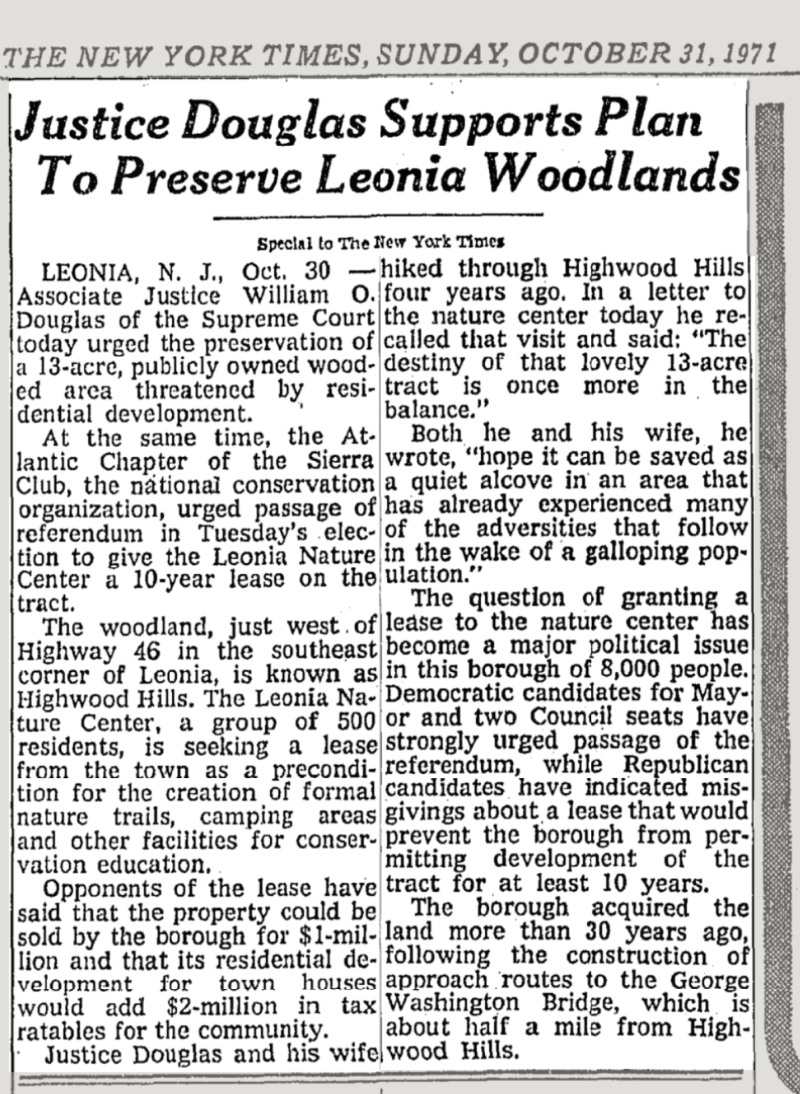
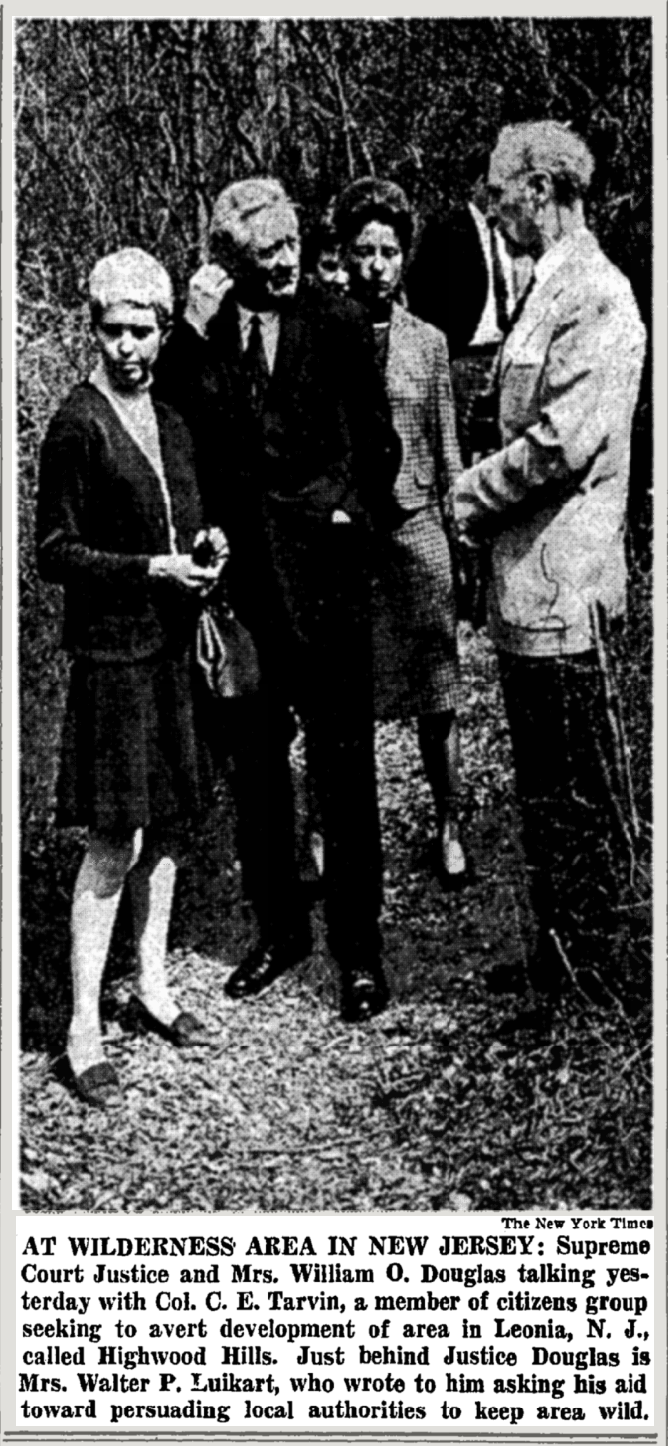
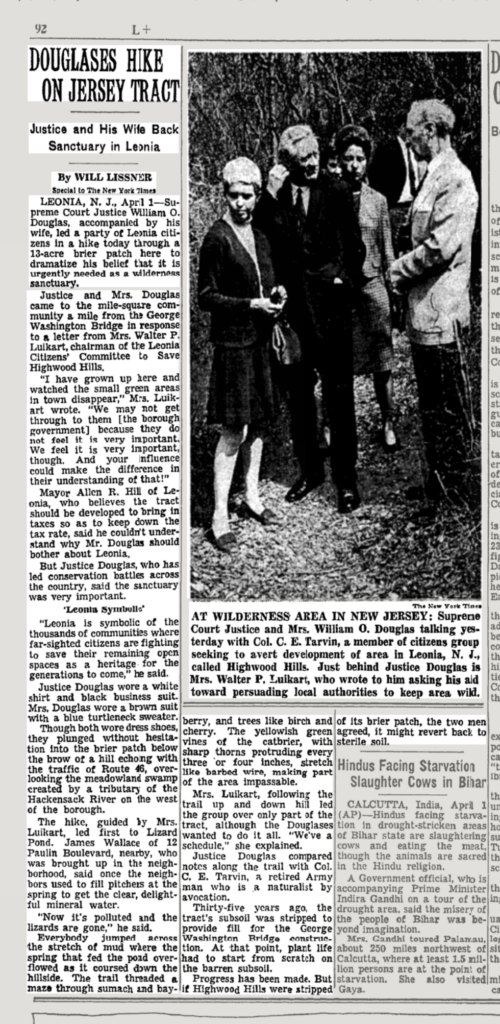
In addition to the systematic mobilization of proecology forces, a contributing factor in the nature center victory was a public endorsement of the proposal by Supreme Court Justice William O. Douglas.
The ecology group, which had emerged slowly over a 10‐year period, and whose membership now numbers about 200 borough families, had pushed vigorously during the year preceding the election to have the site designated as a permanent park. The lease arrangement was viewed as a compromise solution.
Nonetheless, says Mayor Ford, his administration is going ahead with its hopes of having the tract dedicated permanently as a nature site. Hopes for receiving a Federal grant from the Department of Housing and Urban Development have been set back as a results of President Nixon’s budget, however there are plans to try to move forward with an application for state “Green Acre” funds, which would enable the borough to purchase smaller, enclave-like plots within the borough tract.
Mr. Ford said that Green Acre funds were also frozen at this time as a result of the Legislature’s failure to appropriate more than one-fourth of the $40 million that state voters decided to commit to Green Acres in a 1971 referendum. Green Acre funds are granted to municipalities for the purchase of undeveloped tracts, which are then dedicated as parks or natural sites.
A ‘Loose Agreement’
“What we have now is nothing more than a rather loose agrement with the nature center’s board of directors,” Mr. Ford observed.
But the mayor says he is heartened by what he feels is a perceptible switch — even among more conservative segments of the borough electorate — from preoccupations with tax ratables to a broader concern with the quality of life.
“The issue may be cranked up when the lease comes up for renewal,’ Mr. Ford declared, “but I feel the majority will want to keep the tract as a nature center.”
The opposition leader is John Wragge, a long ‐ time borough resident who served on a municipal committee that was established to study the site.
Admitting that “for the moment, it’s no longer an issue,” Mr. Wragge declared that he and many of those who voted against the proposal were still convinced that the decision to “freeze” the property was a mistake.
Of the seven members who served with him on the study committee, he said, only one favored any kind of leasing or dedication of the site. He and other committee members, Mr. Wragge insists, cautioned strongly against entering into any sort of agreement that would tie up the property and prevent its development into tax ratables.
Empahsis on Taxes
Mr. Wragge insists that, until the state’s tax structure is changed, with a shift away from heavy dependence upon local levies, the site must be viewed principally as a tax generator.
In his view, the tract, with its spectacular views, would lend itself to development either with luxury one-family homes or medium-rise apartment houses.
Acknowledging that his opposition forces had been caught up in a “sociological-economic” debate at the time of the referendum, Mr. Wragge says that the nature center is not really necessary, since the borough already has adequate park facilites.
Moreover, he added, Leonia already overextended itself in 1950 by deeding 120 acres to the county for development as part of Overpeck County Park.
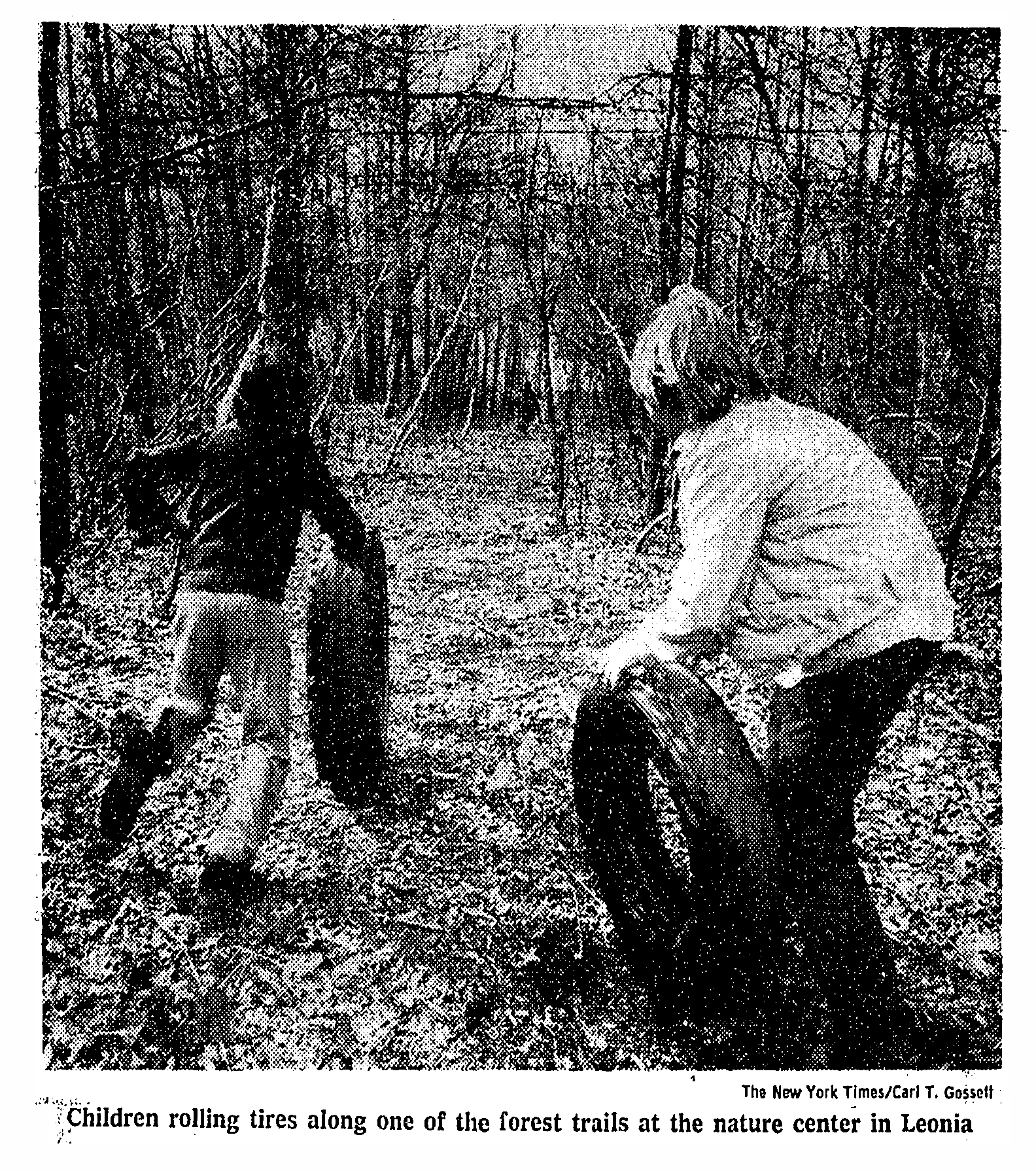
Meanwhile, depsite all the political fireworks still simmering in the community, nature center members are moving forward with an impressive program for the spring and summer. It includes nature walks and talks, an Easter egg hunt, bird watching, nature sketching and sculpture, geology field trips and a jazz concert.
In addition, the center regularly conducts courses in field biology for elementary and high school students.
The nature center’s board of trustees, which is in the midst of changing chairmen following the resignation of Joan Luikart—she withdrew to pursue doctoral studies—has hired a part‐time director for the summer.
He is Tor Hansen, a young artist-naturalist from Englewood, who is active with the nearby Tenafly Nature Center. Mr. Hansen says he is looking forward to helping borough children explore the site and study the many varieties of plant, animal and insect life that abound there.
Children, he says, seem to be the ones who have the deepest appreciation and feel the deepest exhilaration in the presence of nature. His role, as Mr. Hansen views it, is to help them in the “big battle: the swing back from the megalopolis concept of living.”